.svg)


.jpg)
By Daniel Ewusi
25 Nov 2025
Learning through play is not a novel concept; it is as ancient as humanity itself. From children mimicking adult tasks in traditional societies to modern digital games that teach complex subjects, play has always been a fundamental vehicle for knowledge transfer. At Dessel Technologies, we have harnessed this timeless principle to create immersive, effective, and joyful learning experiences in STEM (Science, Technology, Engineering, and Mathematics).
Our approach, rooted in gamification, transforms abstract concepts into tangible adventures.
Whether through our interactive math games that
turn algebra into treasure hunts, fun robotics kits that make engineering accessible,
or game development programs that nurture future tech leaders, we are redefining education.
But why does gamification work so well? And how does it align with cognitive science, cultural relevance,
and real-world success?
Let us explore the psychology behind gamified learning, its global impact,
and how we are applying these principles to empower Africa’s next generation of innovators.
1.1 The Brain on Games: Dopamine, Motivation, and Mastery At its core, gamification leverages the brain’s natural reward system. When a student solves a math puzzle in one of our games or successfully codes a robot to move, their brain releases dopamine, a neurotransmitter associated with pleasure and motivation.
This creates a feedback loop:
Achievement → Dopamine Release → Increased Engagement → Repeat
Studies in neuroeducation (such as those conducted by Stanford’s Graduate School of Education) show that dopamine not only enhances focus but also strengthens memory retention. This explains why students using gamified learning platforms often outperform peers in traditional settings, a phenomenon observed in a 2023 African Development Bank study, where gamified math students in Ghana scored 32% higher in standardised tests.
1.2 The Power of "Safe Failure"
One of the most significant barriers to STEM learning is fear of failure. Many students,
especially in high-pressure academic environments, avoid subjects like math because mistakes feel punitive.
Gamification removes this stigma by reframing errors as part of the learning journey. For example:
In our math adventure games, an incorrect answer doesn’t result in a red "X" but instead offers
hints like, "Close! Try breaking the problem into smaller steps." In robotics, daily challenges
yield iterative testing, and students learn that a malfunctioning robot isn’t a failure but a
chance to debug and improve.
This aligns with the growth mindset theory, developed by psychologist Carol Dweck, which suggests that students who view challenges as opportunities (rather than threats) develop resilience and long-term competency.
1.3 Flow State: The Psychology of Immersive Learning
Have you ever been so engrossed in an activity that time seemed to disappear?
That’s flow state, a mental state of deep focus identified by psychologist Mihaly Csikszentmihalyi.
Games are exceptionally good at inducing flow because they:
Our games are designed to cultivate this state, ensuring students remain engaged for longer periods without burnout — a critical advantage in regions where classroom resources are limited.
Gamification is both a trend and a proven methodology with global success stories. Finnish schools integrate game mechanics into cross-disciplinary projects (e.g., students learn physics by designing virtual roller coasters), with teachers acting as facilitators rather than lecturers. This approach has contributed to Finland's consistent top rankings in global education indices while demonstrating how student-led exploration fosters deeper conceptual understanding.
India's "Mindspark" Adaptive Learning is an AI-powered platform the personalizes math problems as interactive challenges, using real-time data analytics to identify and address individual learning gaps. Improving learning outcomes by 28% in rural schools (J-PAL, 2022), it showcases how adaptive gamification can bridge educational inequality in resource-limited settings.
Kenya's "Eneza Education" is a mobile-based quiz game that has reached over 6 million students through simple SMS technology, proving that low-tech gamification can be scalable and impactful while overcoming infrastructure barriers common across African educational systems.
Our approach transforms STEM education through immersive experiences. The math games are modelled after games that they naturally enjoy playing, and these games turn abstract concepts into engaging adventures by embedding them in culturally relevant narratives like virtual Ghanaian markets, while adaptive AI ensures each learner progresses at their optimal pace. Schools using these tools report 90% improvements in math comprehension within six months.
Our robotics kits turn engineering into pure play, with exciting challenges and friendly competitions that make learning feel like a game. Kids build, code, and battle their creations while unknowingly mastering STEM concepts - because the best learning happens when they're having too much fun to realize they're studying.
For aspiring tech creators, our game development programs teach coding, digital art, and entrepreneurship. Together, these initiatives are building Africa's next generation of innovators through the power of play-based learning.
From cognitive science to real-world applications, gamification is more than a tool—it’s a paradigm shift in education. At Dessel Technologies, we’re proud to pioneer this approach in Africa, proving that when learning is joyful, relevant, and empowering, students don’t just learn—they thrive.
Join the Movement: Explore Our Math Games, Try a Robotics Kit, or Register for Game Dev Training.
"Play is the brain’s favourite way of learning."
“Diane Ackerman”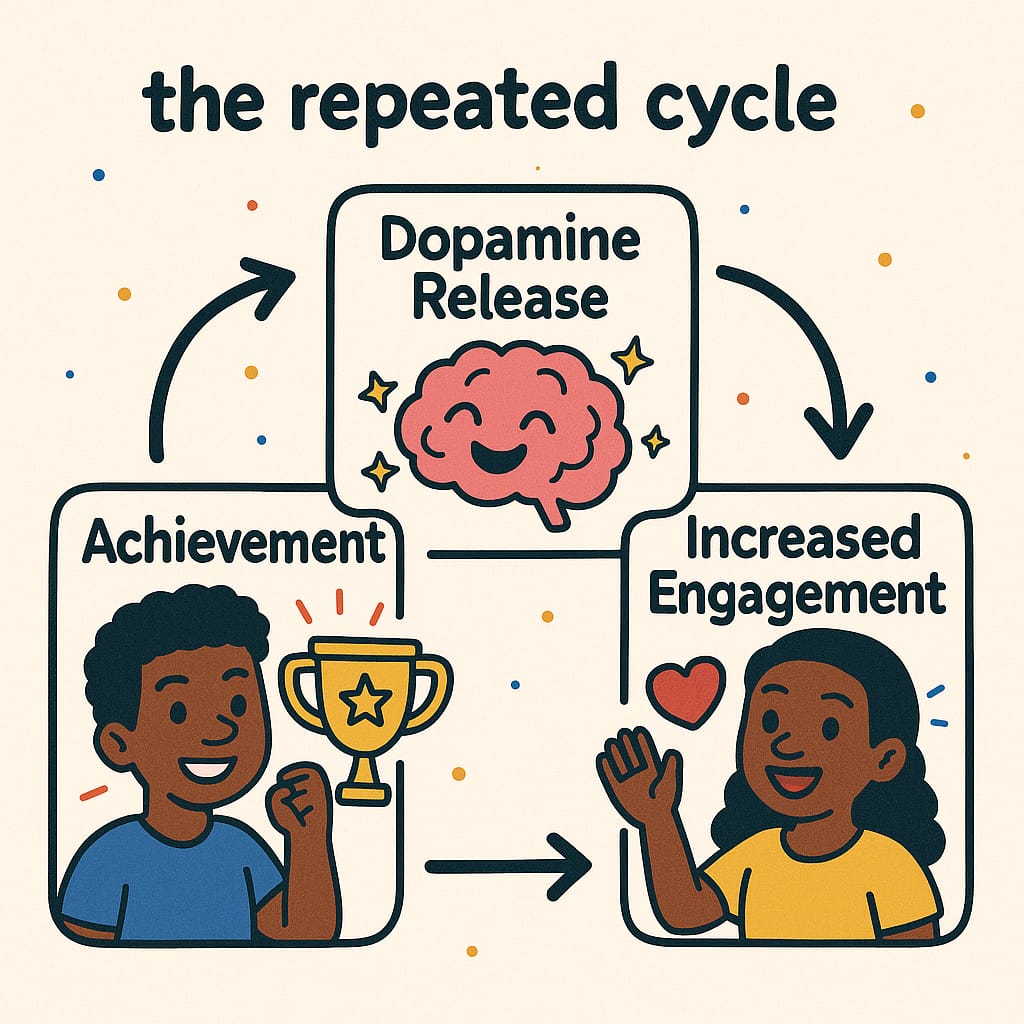


.svg)
 Website